


December 2024
Roy Leckie, Executive Director at Walter Scott
As bottom-up stock pickers, our focus is on company fundamentals rather than constructing portfolios based on macroeconomic views. Indeed, given the roster of current uncertainties facing equity markets, crystal-ball gazing may be a particularly tricky task for 2025.
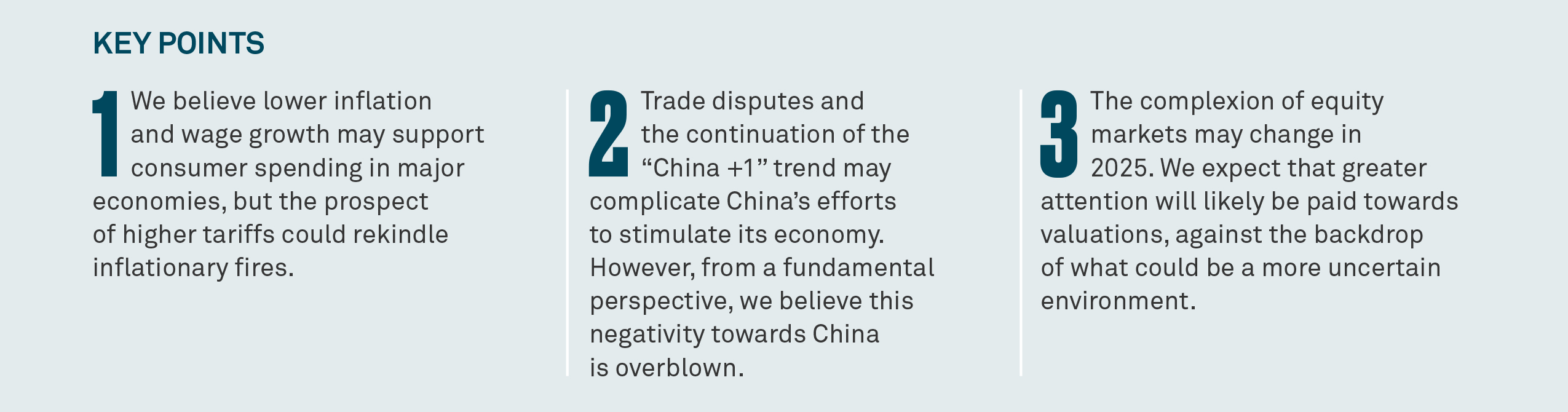
On the plus side, we believe lower inflation and wage growth may support consumer spending in major economies. Coupled with Federal Reserve (Fed) and European Central Bank (ECB) monetary easing, tight-ish labor markets, and China’s stimulus measures potentially stabilizing its economy, a “soft-landing” has become a favored market narrative, with “no-landing” being an outside bet. However, it may not all be plain sailing.
As noted by a number of retailing companies, the cumulative effect of high inflation is still having a lingering impact on price-sensitive consumers.
Complicating the inflation picture is the prospect of higher US tariffs on imported goods, which has the potential to rekindle inflationary fires. This could temper the extent and pace of the Fed’s interest rate cuts, as well as undermine consumer sentiment.
The drift towards protectionism has raised broad concerns over what a tit-for-tat trade war would mean for global growth, especially at a time of a hoped-for improvements in the world’s subdued manufacturing economy. Furthermore, trade disputes and the continuation of the “China +1” trend may complicate China’s efforts to stimulate its economy, at a time when the country is swimming against a tide of negative investor sentiment. From a fundamental perspective, we believe this negativity towards China and its place in the world is overblown. The country is still a huge supplier and demander of the world’s goods and is home to over 1.4 billion consumers.
It remains to be seen if President Trump, the tariff king, or Trump, the dealmaker, turns up at the White House. Likely both. But companies have had years to adapt to a more protectionist world and to implement strategies to mitigate its impact, such as diversifying supply chains or relocating manufacturing. We expect leading companies to be similarly proactive in the event of a new wave of levies.
Potentially lower taxes may provide a near-term adrenalin shot to the US economy. However, a sizeable fiscal giveaway in the context of a burgeoning budget deficit could generate unease in bond markets and propel yields higher. This has been the case in Europe, where events in France have shown that bond and equity investors have not forgotten that there is a cost to fiscal excess. Higher bond yields, with a concomitant impact on the cost of credit, could await those countries which are seen as fiscally adrift.
The complexion of equity markets may change in 2025. We expect that greater attention will likely be paid towards valuations, against the backdrop of what could be a more uncertain environment. Market concentration was a feature of most of last year. Given the rapid buildout of artificial intelligence (AI) infrastructure, Nvidia and other select semiconductor companies and “hyperscalers” including Alphabet, were a focus of attention. We expect the market’s gaze will broaden. As AI infrastructure continues to expand, more attention will be paid about how it is being used. We believe investors will be more discerning, focusing, as we are, on how companies are identifying and monetizing realworld opportunities that AI presents in terms of reaching customers more efficiently and more profitably, with better products and services.
Tense global political relations have not been reflected in equity markets, as they have not disrupted energy markets or supply chains. However, in our view, any escalation of the conflicts in the Middle East and Ukraine still has the potential to generate volatility.
Irrespective of these near-term caveats, we remain resolutely optimistic about equity returns over the long term. Many of the world’s leading companies are political and economic cycle veterans, although they may not be immune from earnings and share price volatility. However, in our view, their attributes of financial strength, market leadership, and ability to adapt and innovate will enable them to take advantage of long-term trends that will outlast any short-term headwinds.
Artificial intelligence (AI) is the ability of computers to perform tasks commonly associated with intelligent beings.
China +1 refers to a strategy in which companies avoid investing only in China and diversify business into other countries.
Hyperscalers are large-scale data centers that provide a wide range of cloud computing and data solutions.
No landing refers to an economy that does not slow down, and upside risks to inflation come back after the initial decline in inflation.
Soft landing is a cyclical slowdown in economic growth that avoids a recession.
All investments involve risk, including the possible loss of principal. Certain investments involve greater or unique risks that should be considered along with the objectives, fees, and expenses before investing.
Company information is mentioned only for informational purposes and should not be construed as investment or any other advice. The holdings listed should not be considered recommendations to buy or sell a security.
BNY Investments is one of the world’s leading investment management organizations, encompassing BNY’s affiliated investment management firms and global distribution companies. BNY is the corporate brand of The Bank of New York Mellon Corporation and may be used to reference the corporation as a whole and/or its various subsidiaries generally.
This material has been provided for informational purposes only and should not be construed as investment advice or a recommendation of any particular investment product, strategy, investment manager or account arrangement, and should not serve as a primary basis for investment decisions.
Prospective investors should consult a legal, tax or financial professional in order to determine whether any investment product, strategy or service is appropriate for their particular circumstances. Views expressed are those of the author stated and do not reflect views of other managers or the firm overall. Views are current as of the date of this publication and subject to change.
The information is based on current market conditions, which will fluctuate and may be superseded by subsequent market events or for other reasons. References to specific securities, asset classes and financial markets are for illustrative purposes only and are not intended to be and should not be interpreted as recommendations. Information contained herein has been obtained from sources believed to be reliable, but not guaranteed. No part of this material may be reproduced in any form, or referred to in any other publication, without express written permission.
Walter Scott & Partners Limited (“Walter Scott”) is an investment management firm authorized and regulated in the United Kingdom by the Financial Conduct Authority in the conduct of investment business. Walter Scott is a subsidiary of The Bank of New York Mellon Corporation.
© 2024 BNY Mellon Securities Corporation, distributor, 240 Greenwich Street, 9th Floor, New York, NY 10286.